Most abandonment journeys fail for one simple reason:
they assume all abandonment means the same thing.
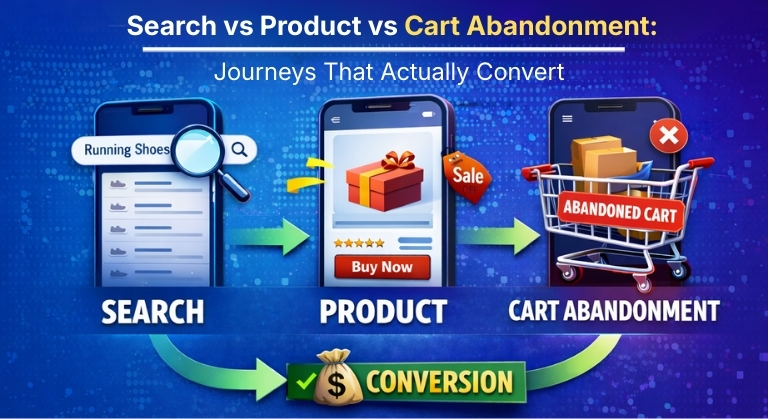
A user who searched for a product, a user who viewed the same product three times, and a user who added an item to cart are all treated as “lost.” In reality, they are at three very different stages of decision-making.
When CRM treats them the same, brands either:
- push urgency too early,
- discount unnecessarily, or
- overwhelm users who were never ready to buy.
This is why abandonment journeys often recover short-term revenue but damage long-term retention.
To fix this, abandonment must be designed around intent depth, not funnel labels.
Why Abandonment Is an Intent Problem, Not a Drop-Off Problem
Abandonment doesn’t mean rejection.
It means pause, hesitation, or unfinished evaluation.
Most CRM systems trigger journeys based on what didn’t happen (no purchase), rather than what did happen (how the user behaved before leaving).
This creates two problems:
- Early-stage users get pressured before intent forms
- High-intent users don’t get the help they actually need
Effective abandonment journeys start by answering one question:
What decision was the user trying to make when they left?
Understanding Intent Depth Across Abandonment Types
Search Abandonment – Exploratory Intent
Search behavior is curiosity-led, not commitment-led.
When a user searches:
- they’re comparing options,
- checking availability,
- or validating feasibility (price, timing, use case).
Search abandonment usually means “I’m still figuring this out.”
What it does not mean:
- readiness to purchase
- openness to urgency
- need for a discount
Treating search abandonment like cart abandonment is one of the fastest ways to create early fatigue.
Product Abandonment – Evaluation Intent
Product abandonment shows consideration, not indecision.
These users:
- spent time understanding features,
- revisited the same product,
- or compared alternatives.
What’s missing is not motivation – it’s confidence.
Product abandonment signals a need for:
- reassurance,
- clarity,
- proof,
- or objection handling.
This is where CRM can genuinely help users decide.
Cart Abandonment – High Intent with Friction
Cart abandonment is fundamentally different.
These users:
- made a decision,
- encountered friction,
- or postponed completion.
Common friction points include:
- price shock,
- unclear delivery timelines,
- trust or payment concerns,
- poor checkout experience.
Cart abandonment is the only stage where urgency and incentives can work – if used with restraint.
Comparative Journey Design by Intent Level
Factor | Search | Product | Cart |
Intent level | Low | Medium | High |
CRM goal | Guide | Reassure | Remove friction |
Trigger window | 24-48 hrs | 6-12 hrs | 30 min-2 hrs |
Content type | Discovery | Proof & clarity | Urgency & trust |
Discount usage | Avoid | Rare | Conditional |
Designing one abandonment journey for all three stages guarantees misalignment.
Designing Search Abandonment Journeys That Don’t Feel Pushy
What Works
Search abandonment journeys should extend exploration, not force conversion.
Effective approaches include:
- curated collections based on the search
- popular or trending alternatives
- educational content (guides, comparisons)
- alerts for price drops or availability
Example trigger:
User searched the same category or destination twice within 7 days but did not view a product.
Example intent:
Help the user move from search → consideration.
What to Avoid
- urgency language (“last chance”)
- discounts
- repeated reminders within short intervals
Early pressure breaks trust before it’s built.
Designing Product Abandonment Journeys That Build Confidence
Product abandonment journeys should answer:
“Is this right for me?”
What Works
- social proof and reviews
- feature highlights tied to use cases
- FAQs addressing common objections
- comparisons with similar products
Example trigger:
Viewed the same product 2+ times or spent significant time on the product page without adding to cart.
Example intent:
Reduce uncertainty, not create urgency.
Smart Escalation Logic
If product views repeat without progression:
- reinforce value
- address objections
- only then consider incentives – selectively
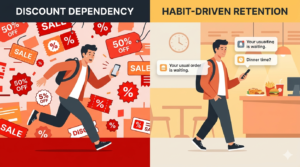
Default discounts at this stage train users to wait.
Designing Cart Abandonment Journeys That Resolve Friction
Cart abandonment journeys should focus on completion clarity.
What Works
- fast reminders (within 30-60 minutes)
- delivery timelines and return clarity
- trust badges and payment reassurance
- support access or FAQs
Example trigger:
Added to cart but did not initiate checkout within 30 minutes.
Example intent:
Remove the last obstacle.
Conditional Incentives, Not Blanket Discounts
Incentives should be:
- delayed until value-based nudges fail
- time-bound
- excluded for repeat abusers
Otherwise, abandonment becomes a discount strategy.
Channel Strategy – Matching Channel to Intent
- Search abandonment: Email, in-app
- Product abandonment: Email → push (if opted in)
- Cart abandonment: Push, WhatsApp, email fallback
Sequencing matters more than channel count.
More messages do not equal more intent.
Measuring What Actually Matters
Avoid measuring abandonment journeys only by recovered revenue.
Track:
- progression rates between stages
- time-to-next-action
- suppression effectiveness
- long-term discount dependency
The goal is better decisions, not louder reminders.
Final Takeaway
Search, product, and cart abandonment represent three different decision states, not one failure.
When journeys are designed around:
- intent depth,
- decision context,
- and friction type,
CRM stops feeling intrusive and starts feeling helpful.
If your abandonment journeys look identical across stages, you’re likely pressuring early intent and under-serving high intent.
At ConSoul, we design abandonment journeys based on behavior and intent, not templates-so every message earns attention.