Most CRM programs don’t fail loudly.
They fail quietly.
Messages are delivered. Journeys run. Dashboards update.
Yet retention plateaus, reactivation weakens, and engagement becomes increasingly incentive-driven.
This case study breaks down how shifting from rule-based CRM to behavior-led lifecycle journeys helped improve retention quality across BFSI, OTT, and eCommerce use cases – without increasing message volume or discount reliance.
The Starting Point – CRM That Looked “Fine” on Paper
Across industries, the initial CRM setups shared common traits:
- Journeys triggered on static rules
- Heavy dependence on time-based logic
- Reactivation driven by inactivity thresholds
- Promotions used as the default lever
From a reporting standpoint:
- open rates were acceptable
- campaigns were going out on time
- revenue attribution existed
But underneath, engagement quality was degrading.
The Symptoms That Triggered Investigation
Despite “working” CRM programs, teams noticed consistent issues:
1. Retention Was Flat
Users were not churning immediately – but they weren’t deepening engagement either.
2. Reactivation Quality Was Poor
Users returned briefly after win-back messages, then dropped again.
3. Discount Dependency Increased
Incentives were becoming necessary earlier in the lifecycle.
4. Message Fatigue Signals Emerged
Opt-outs, ignored pushes, and declining CTRs appeared – especially among active users.
These weren’t execution problems.
They were signal interpretation problems.
The Core Diagnosis – CRM Was Reacting Too Late
The investigation revealed a consistent flaw across setups:
CRM was designed to react to inactivity, not decline.
Journeys triggered only when users:
- stopped transacting,
- crossed inactivity windows,
- or failed to respond for fixed periods.
By the time CRM acted, the user had already disengaged mentally.
This meant:
- reactivation messages had to work harder,
- incentives had to be stronger,
- and recovered users were fragile.
The opportunity was earlier – hidden in behavioral decay signals.
The Strategic Shift – From Rules to Behavioral States
Instead of building more journeys, the approach changed direction.
What was removed
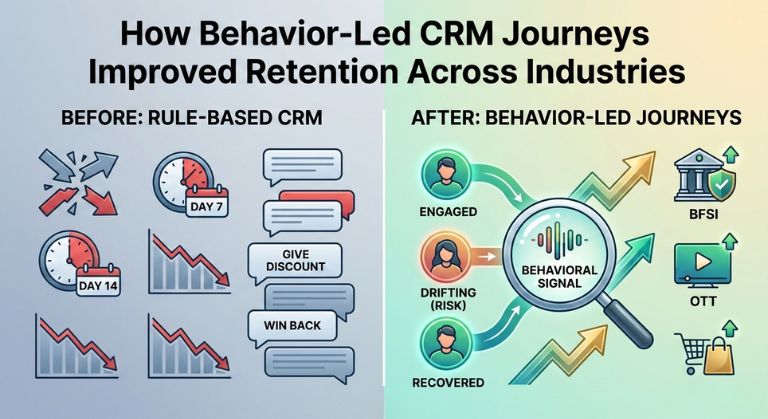
- rigid “Day 7 / Day 14” logic
- single-event triggers
- blanket reactivation rules
What replaced it
A behavior-led lifecycle model, where users moved between states based on patterns, not timestamps.
The key question became:
“Is the user behaving like someone who is still engaged – or someone who is drifting?”
Identifying the Right Behavioral Signals
Across industries, the same high-signal patterns emerged:
1. Frequency Decay
Users didn’t stop entirely – they showed up less often.
2. Depth Reduction
Actions became shallower (browse without explore, play without complete).
3. Feature Drop-Off
Key features used earlier were no longer touched.
4. Response Lag
Users delayed or ignored nudges they previously engaged with.
These signals appeared weeks before inactivity thresholds.
Journey Redesign – What Changed in Practice
Step 1: Introduced a “Risk” State
Instead of jumping from Active → Win-back, a middle state captured early disengagement.
Step 2: Built Soft Interventions
Risk-stage journeys focused on:
- relevance reminders
- value reinforcement
- usage cues
No urgency. No discounts.
Step 3: Suppressed Noise for Active Users
Active users were removed from:
- promotional blasts
- reactivation journeys
- aggressive nudges
This reduced fatigue significantly.
Step 4: Escalation Only If Decline Continued
Only users who did not recover from soft interventions progressed to stronger win-back logic.
Industry-Specific Outcomes
BFSI
- Reduced premature reactivation messaging
- Higher quality engagement post-intervention
- Less dependency on rewards for activity
OTT
- Improved content consumption continuity
- Early recovery before subscription lapses
- Better personalization driven by behavior, not genre tags
eCommerce
- Higher repeat purchase quality
- Lower discount leakage
- Improved progression from browse → purchase
Across all cases, CRM volume stayed roughly the same – impact increased.
What Didn’t Change (Intentionally)
This wasn’t a tech overhaul.
- Platforms stayed the same
- Channels stayed the same
- Creative effort stayed constant
The improvement came purely from better interpretation of behavior.
Metrics That Told the Real Story
Instead of celebrating clicks, teams tracked:
- recovery before inactivity
- sustained engagement post-reactivation
- reduction in discount-triggered conversions
- lifecycle state progression
These metrics correlated far more strongly with long-term retention.
Key Learnings From the Case Study
- Inactivity is a lagging indicator
- Behavioral decay is visible early
- Soft interventions outperform aggressive ones
- Suppression is as important as triggering
- Better CRM doesn’t mean louder CRM
Final Takeaway
Behavior-led CRM doesn’t require more messages, better copy, or bigger incentives.
It requires:
- earlier detection,
- smarter state design,
- and restraint in execution.
When CRM reacts to how users are changing, not just what they stopped doing, retention becomes sustainable – not forced.
If your CRM only reacts after users disengage, you’re already late.
At ConSoul, we design behavior-led lifecycle systems that detect decline early – so retention happens before recovery becomes expensive.