If your CRM feels busy but ineffective, the problem is rarely creativity.
Most brands don’t suffer from a lack of journeys.
They suffer from journeys running without a shared operating logic.
Onboarding emails collide with promotions.
Retention nudges overlap with reactivation.
Win-back messages fire while users are still active.
Individually, each journey makes sense.
Together, they create noise.
This is where most CRM programs quietly fail – not at the campaign level, but at the lifecycle design level.
The Hidden CRM Problem No One Owns
Ask most teams who owns lifecycle design and you’ll hear:
- Growth owns onboarding
- Marketing owns campaigns
- CRM owns journeys
- Retention owns churn
What no one owns is how these parts interact.
CRM platforms execute journeys well.
They do not decide which journey deserves attention at which moment.
Without a unifying map, CRM becomes reactive, fragmented, and eventually fatiguing.
Why More Journeys Make Performance Worse
A common misconception:
“If one journey works, more journeys will work better.”
In practice, the opposite happens.
More journeys lead to:
- competing triggers
- message collisions
- inconsistent intent signals
- inflated frequency without impact
Users don’t experience “campaigns.”
They experience a stream of interruptions.
The real problem is not volume – it’s lack of prioritization.
Introducing the CRM Victory Map (What It Is – and Isn’t)
A CRM Victory Map is not:
- a funnel
- a canvas
- a set of flows
It is a decision system that answers three questions at all times:
- Where is the user in their lifecycle right now?
- What is the single most important CRM job at this stage?
- Which journeys must be suppressed to protect that job?
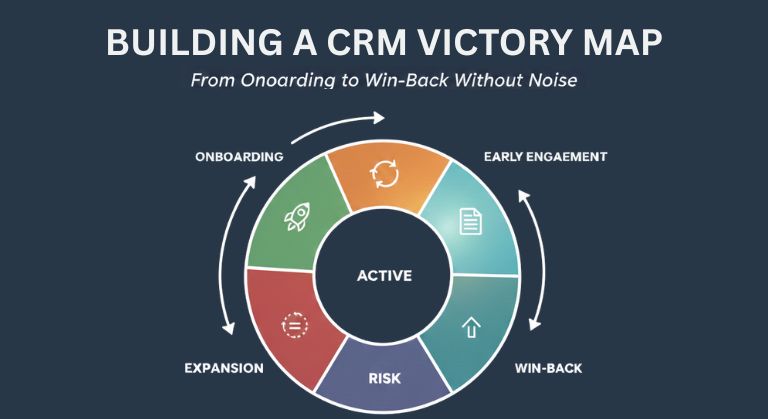
The Victory Map replaces campaign-first thinking with state-first thinking.
The Lifecycle States That Actually Matter
Instead of dozens of micro-stages, the Victory Map works with six macro states that reflect real user psychology.
1. Onboarding – “Help Me Get Value”
User mindset:
“I’m trying to understand if this was a good decision.”
CRM’s job:
Accelerate first value and reduce confusion.
Journeys that belong here:
- setup guidance
- feature discovery
- usage nudges
- educational content
Journeys that do NOT belong here:
- cross-sell
- promotions
- loyalty messaging
Most onboarding fails because brands rush users toward revenue before trust forms.
2. Early Engagement – “Does This Fit My Routine?”
User mindset:
“I’ve tried it once. Will I come back?”
CRM’s job:
Reinforce relevance and habit.
Journeys that belong here:
- reminders tied to past behavior
- contextual tips
- light personalization
Critical rule:
Do not introduce urgency here. Habit beats pressure.
3. Active – “This Works for Me”
User mindset:
“I know what I’m doing.”
CRM’s job:
Stay useful without interrupting.
Journeys that belong here:
- preference learning
- subtle reinforcement
- value reminders
This is where most CRM programs overstep – flooding active users with messages they don’t need.
4. Expansion – “What Else Can This Do?”
User mindset:
“I trust this brand.”
CRM’s job:
Expand value, not push offers.
Journeys that belong here:
- feature adoption nudges
- contextual upgrades
- use-case expansion
Expansion works when it feels like enablement, not selling.
5. Risk – “I’m Drifting Away”
User mindset:
(Usually invisible) disengagement
CRM’s job:
Detect decline before inactivity.
Signals that matter:
- reduced frequency
- partial feature drop-off
- slower response to nudges
Most brands wait until users are gone.
Effective CRM intervenes while recovery is still possible.
6. Win-Back – “Convince Me It’s Worth Returning”
User mindset:
“I’ve moved on.”
CRM’s job:
Reintroduce relevance – or exit cleanly.
Journeys that belong here:
- strong contextual reminders
- clear value framing
- limited, meaningful incentives
Win-back should be intentional, not endless.
The Governance Layer Most CRM Setups Miss
Journeys don’t fail because they’re poorly written.
They fail because nothing stops them from running together.
A Victory Map enforces:
- one primary lifecycle state per user
- explicit entry and exit rules
- mutual exclusions between states
Example rules:
- Users in Active cannot receive Win-Back
- Users in Onboarding are suppressed from promotions
- Users in Risk are excluded from broadcast campaigns
Governance is what turns CRM from chaos into strategy.
Measuring Success the Right Way
Stop measuring every journey with:
- open rates
- clicks
- short-term revenue
Instead, measure state progression.
Lifecycle State | Metric That Matters |
Onboarding | Time to first value |
Early engagement | Repeat usage |
Active | Consistency |
Expansion | Feature adoption |
Risk | Recovery rate |
Win-back | Quality of return |
If users aren’t moving forward, CRM isn’t working – no matter how good the numbers look.
How to Build Your Victory Map (Practically)
- List all live journeys
- Assign each journey to one lifecycle state
- Identify overlaps and conflicts
- Define suppression and exit rules
- Remove journeys with no clear lifecycle job
Most teams discover they need fewer journeys, not more.
Final Takeaway
CRM doesn’t fail because teams don’t try hard enough.
It fails because structure comes after execution.
A CRM Victory Map ensures:
- the right journey runs at the right time
- users aren’t overwhelmed
- CRM feels intentional, not reactive
If your CRM feels noisy despite strong journeys, the issue isn’t messaging – it’s lifecycle design.
At ConSoul, we build CRM systems around states, priorities, and governance, so every journey earns attention.