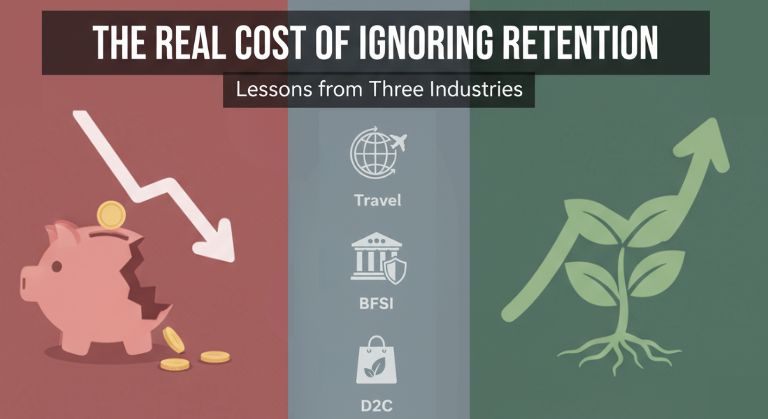
Every marketer talks about acquisition. Few measure what it costs to replace the customers they lose.
At ConSoul, we’ve spent years helping brands shift from chasing new users to retaining the ones they already earned- and the numbers are revealing.
Ignoring retention isn’t just inefficient. It’s expensive, invisible, and often irreversible.
Retention vs. Acquisition- A Data Reality Check
Across categories, acquiring a new customer costs 5–7 times more than retaining an existing one.
But the gap isn’t just financial- it’s structural.
- Travel: Acquisition is highly seasonal; retention builds stability between seasons.
- BFSI: Cross-sell and loyalty drive margins; new users often require costly onboarding.
- D2C: CACs have surged 60–80% post-2022, while repeat buyers contribute 45–60% of total revenue.
Retention isn’t just a “CRM function.” It’s the compounding interest of marketing.
Industry 1- BFSI: Retention as a Trust Engine
In banking and fintech, the challenge isn’t getting sign-ups- it’s keeping engagement after the first transaction.
We worked with a major BFSI brand where 60% of digital accounts went inactive within 90 days.
Our solution combined three data-led layers:
- Engagement Scoring: Measured app interactions, transaction depth, and time between sessions.
- Micro-Triggers: Automated reminders around EMI dates, statements, and small wins like “Your card usage hit a milestone.”
- Human Touchpoints: Periodic satisfaction prompts routed through relationship managers.
Outcome: Within one quarter, activation retention rose by 38% and referral-led acquisitions grew organically by 14%.
Retention in BFSI isn’t about offers- it’s about building confidence through continuity.
Industry 2- Travel: Turning Intent Into Loyalty
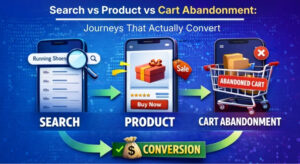
A leading online travel platform was losing 70% of its users between “search” and “checkout.”
Instead of more discounts, ConSoul built a behaviour-driven abandonment sequence that adjusted follow-ups based on:
- Destination frequency,
- Price sensitivity, and
- Device usage patterns.
Example:
Users who searched Toronto → Vancouver three times received a contextual email- “Still planning your Vancouver trip?”- paired with real-time fare drops.
No promo codes. No spam.
The brand achieved a 2x increase in conversions and cut remarketing spend by 40%.
Retention here began before the first booking.
Industry 3- D2C: The Post-Purchase Blindspot
In D2C, brands obsess over the first conversion and forget the second.
We worked with a sustainable lifestyle brand that discovered 82% of buyers never returned after one purchase.
Our post-purchase loop introduced three interventions:
- Usage Feedback: “How are you liking your new product?”
- Care Content: A short email with tips for product longevity (aligned with the brand’s eco-mission).
- Reactivation Incentive: Instead of discounts, users unlocked early access to a new drop after engaging twice.
The result: repeat purchases grew by 27% in 60 days.
Retention isn’t driven by incentives- it’s driven by relevance and timing.
Why Retention Is Everyone’s Job
Retention is not a department.
It’s the invisible connective tissue across marketing, product, and customer service.
- Product teams create consistency through usability.
- CRM teams identify moments to re-engage.
- Performance teams allocate budgets based on lifecycle value.
When all three align, retention becomes a multiplier, not a metric.
ConSoul’s Framework- From Reactive to Predictive Retention
Most brands measure churn after it happens.
Our retention framework flips the logic:
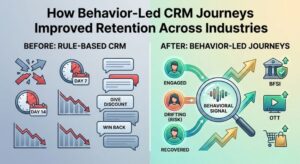
Stage 1: Detect– Using engagement decay curves to flag early drop risks.
Stage 2: Design– Automate reactivation sequences based on behavioural clusters.
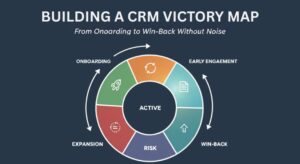
Stage 3: Deepen– Build “micro-loyalty” layers- small, consistent value moments that make users stay longer.
Retention is not one campaign; it’s an ecosystem that learns.
The Takeaway
Retention isn’t a project you run once a year.
It’s a mindset shift that redefines ROI from “reach” to “relationship.”
When done right, it reduces acquisition dependency, increases predictability, and makes marketing measurable in ways ads alone never can.
Retention is the new growth channel.
→ Discover how ConSoul helps brands design retention-first growth strategies across industries