Not every user shouts before they leave. Some whisper.
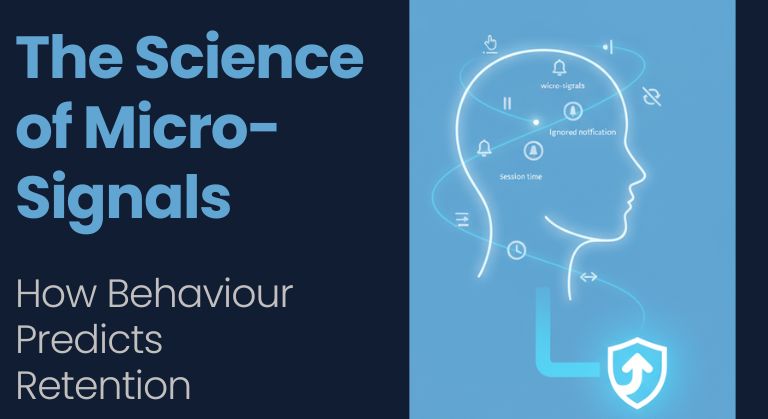
The most powerful predictors of churn are hidden in micro-behaviours- tiny digital actions that reveal intent long before a drop-off.
At ConSoul, we build lifecycle strategies around those whispers. Because every scroll, pause, or hesitation is data about motivation. And when you can read those signals, you can change the story.
What Are Micro-Signals?
Micro-signals are behavioural indicators that sit between metrics and moments.
They don’t exist in dashboards by default- you must extract them from patterns.
Common examples include:
- Scroll depth without conversion (interest but hesitation)
- Repeated visits to the same page (intent reaffirmation)
- Shortening session times over weeks (attention fatigue)
- Ignored push notifications (signal saturation)
Each micro-signal alone is noise; combined, they tell a behavioural story.
Why Traditional Metrics Aren’t Enough
Open rates, CTR, and bounce rates measure response, not emotion.
They can tell you what happened, never why.
We found that brands relying only on standard metrics react too late. By the time a user stops opening emails, their disengagement started 10 days earlier in micro-signals.
For one eCommerce brand, shifting focus to behavioural data revealed that users who paused checkout for > 30 seconds on mobile were 40% more likely to abandon. We added a contextual nudge within that window- conversion rose by 18%.
Micro-signals don’t replace analytics. They make analytics human.
How We Decode Micro-Signals at ConSoul
We treat behaviour as data, but analyse it like psychology. Our process follows four steps:
- Collect intent-rich events– scroll depth, time on page, click density, and cursor movement (using heatmaps and journey logs).
- Cluster patterns– group users by behavioural velocity (fast browsers vs deep readers vs repeat visitors).
- Correlate with outcomes– connect micro behaviours to macro results (purchase, drop-off, referral).
- Trigger responses– personalised messaging or journey branching based on behavioural stage.
This behavioural layer lets us predict user fatigue and design interventions before a drop occurs.
Case Study- Early Reactivation in EdTech
An education platform was losing students after the first week of course enrolment.
Traditional CRM metrics flagged them as “inactive” after 14 days- too late.
We built a micro-signal model that flagged users who:
- Stopped scrolling through modules mid-way.
- Reduced session length by > 30%.
- Skipped more than two quizzes in a row.
Those users received contextual nudges like: “Your next lesson unlocks a badge- resume now.”
Engagement rebounded in 48 hours and overall course completion rose 22%.
The insight: drop-off wasn’t disinterest- it was momentary friction.
Framework- From Data to Decision
ConSoul’s Behaviour-Led Lifecycle Framework bridges micro data with macro strategy.
Stage | Signal Type | Action | Outcome |
Discover | Curiosity signals (hover time, scroll depth) | Personalised content sequence | Higher content retention |
Decide | Hesitation signals (back and forth between plans) | Dynamic FAQs + trust nudges | Reduced abandonment |
Use | Fatigue signals (session time drops) | Contextual push with value add | Increased daily active users |
Re-engage | Drift signals (inactivity > 14 days) | Reactivation email + content recap | Faster return rate |
Micro-Signals vs Personalisation 2.0
Traditional personalisation stops at “Hi {name}.”
Behavioural personalisation adapts in real time.
For a BFSI client, we monitored micro behaviours inside their app- where users paused while applying for loans. By embedding in-app clarity tooltips right before those points, form completion rose by 31%.
True personalisation is not about profiles- it’s about predicting confusion.
Common Missteps Brands Make
- Over-instrumentation– tracking every event creates noise and privacy issues.
- Isolated analysis– seeing micro signals without journey context leads to false positives.
- Lack of response logic– collecting behaviour without an automation plan.
ConSoul’s rule: If you track it, decide why and what you’ll do when it changes.
Building a Culture That Understands Micro-Behaviour
Tools can track behaviour, but teams must interpret it.
We encourage clients to run monthly “behaviour roundtables”- cross-functional reviews where CX, marketing and product teams decode behaviour together.
It’s less about dashboards and more about stories: why did the user hesitate? why did they return?
The Takeaway
Micro-signals aren’t minor data points- they’re the language of customer emotion.
When brands learn to listen to them, retention stops being a reaction and becomes a relationship.
The difference between a churned user and a loyal one is often just a few unread signals.
→ Learn how ConSoul uses behavioural data to build predictive journeys that keep users engaged