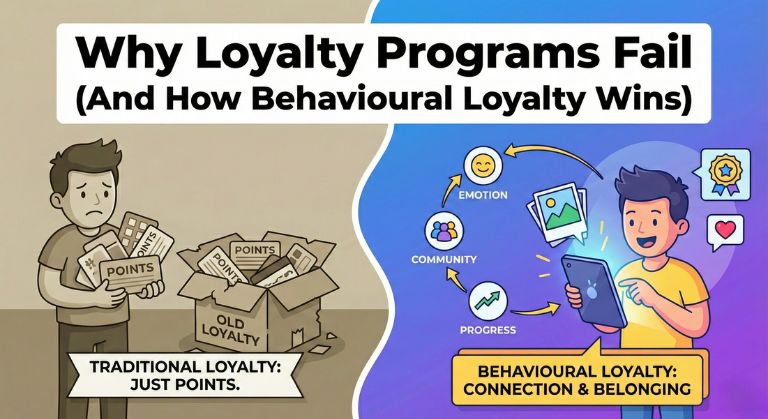
Points, tiers, and discounts- the holy trinity of traditional loyalty programs.
They worked when customer choices were limited, and switching costs were high. But today, every product is one click away, every discount is one copycat deep.
At ConSoul, we’ve seen loyalty fail not because people stop loving brands, but because brands stop learning from people.
Behavioural loyalty fixes that gap- by making every interaction a feedback loop, not a transaction.
The Loyalty Illusion- When Points Stop Paying Off
Most loyalty programs over-index on purchase frequency and ignore emotional frequency.
They reward buying, not belonging.
In 2023, 78% of consumers globally were enrolled in at least one loyalty program, but only 45% actively used them.
Why? Because rewards are too transactional, and experiences too generic.
A coffee chain giving 10th-cup-free incentives doesn’t build loyalty; it builds habit until someone else gives the 9th cup free.
Loyalty isn’t price elasticity- it’s emotional affinity.
Case Study- From Points to Participation (BFSI Example)
A large BFSI brand came to us with a loyalty problem: 1.5 million users, but declining active participation despite new reward tiers.
The loyalty engine rewarded only spending- not engagement.
We redesigned the framework around micro-actions:
- Completing digital KYC.
- Setting financial goals in-app.
- Referring a friend.
- Consistent monthly savings.
Each action triggered contextual recognition (not just points): badges, progress dashboards, and personalized milestone nudges.
Within 90 days:
- Active participation rose 32%.
- Inactive users dropped by 18%.
- Referral-based acquisition grew 11%.
Behaviour created engagement- the points were just punctuation.
The Psychology Behind Behavioural Loyalty
Loyalty is driven by three motivators: Autonomy, Achievement, and Recognition.
- Autonomy: users want to choose how they earn or engage. Give flexible ways to participate.
- Achievement: reward completion, not just consumption. A badge earned feels more personal than a coupon applied.
- Recognition: public or private acknowledgment- “You’ve unlocked our Top Contributor Tier”- triggers dopamine far stronger than a discount.
ConSoul’s frameworks integrate all three, ensuring that loyalty feels like progress, not payout.
Why Traditional Loyalty Programs Break Down
Let’s dissect the five most common reasons loyalty engines underperform:
|
Problem |
Consequence |
Behavioural Fix |
|
Rewards only tied to spend |
Users disengage post-purchase |
Add engagement and feedback milestones |
|
One-size-fits-all tiers |
Mid-segment users feel ignored |
Use dynamic tiers based on behaviour depth |
|
Lack of surprise |
Predictable rewards = fatigue |
Introduce random micro-rewards |
|
Static communication |
Feels impersonal and mechanical |
Trigger real-time contextual nudges |
|
No post-redemption engagement |
Loyalty loop ends abruptly |
Continue with reactivation triggers |
Loyalty fails when it becomes a department instead of a design philosophy.
Case Study- Behavioural Loyalty in D2C
A sustainable D2C brand noticed high first-purchase conversion but weak repeat intent.
Their “5% off next purchase” strategy was driving discounts, not devotion.
We replaced it with a behavioural loyalty engine that rewarded:
- UGC uploads (customer photos on social).
- Product reviews within 7 days.
- Sharing eco-tips from the brand’s blog.
Each action unlocked non-monetary perks- early access, product naming votes, limited-edition colours.
The impact was immediate:
- Repeat rate +24%.
- User-generated content tripled.
- Customer satisfaction scores increased 19%.
This is how loyalty becomes advocacy.
Framework- ConSoul’s Behavioural Loyalty Loop
Our approach is built on three continuous phases:
- Detect: Identify valuable micro-actions (referrals, reviews, repeat visits).
- Design: Map these actions to motivational rewards (status, access, recognition).
- Deepen: Reinforce behaviours through contextual journeys, not static offers.
This creates a loyalty loop– where engagement generates data, data refines journeys, and journeys inspire more engagement.
Data + Emotion = Retention
Behavioural loyalty isn’t anti-data- it’s data with empathy.
We use interaction analytics to understand emotional momentum- when users feel seen, not sold to.
For a retail client, tracking “review submission after delivery” became the single strongest retention predictor.
We automated appreciation messages and VIP previews for those reviewers. Their churn dropped 28%.
Loyalty was hidden in gratitude, not gamification.
The Future of Loyalty- From Programs to Platforms
Tomorrow’s loyalty isn’t a static app- it’s a dynamic experience layer integrated into every customer touchpoint.
Your product, app, and marketing should all speak the same behavioural language.
At ConSoul, we call this the Loyalty-as-Experience model- where personalization, retention, and feedback are interconnected, not departmentalised.
The result: loyalty that evolves as fast as your users do.
The Takeaway
Loyalty isn’t built in points dashboards; it’s built in the small, consistent acknowledgments that tell users they matter.
When brands shift from rewarding transactions to reinforcing behaviours, loyalty stops being a program- it becomes a partnership.
The strongest loyalty isn’t earned; it’s understood.