Consoul Solutions LLP

Vani Garg

Consoul 2

Search vs Product vs Cart Abandonment – Journeys That Actually Convert 

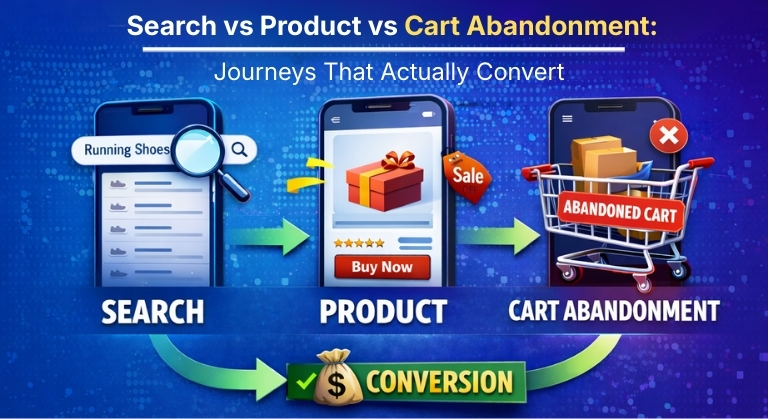
  Most abandonment journeys fail for one simple reason: they assume all abandonment means the same thing.  A user who searched for a product, a user who viewed the same product three times, and a user who added an item to cart are all treated as “lost.” In reality, they are at three very different stages of decision-making.  When CRM treats them the same, brands either:  push urgency too early,  discount unnecessarily, or  overwhelm users who were never ready to buy.  This is why abandonment journeys often recover short-term revenue but damage long-term retention.  To fix this, abandonment must be designed around intent depth, not funnel labels.    Why Abandonment Is an Intent Problem, Not a Drop-Off Problem    Abandonment doesn’t mean rejection. It means pause, hesitation, or unfinished evaluation.  Most CRM systems trigger journeys based on what didn’t happen (no purchase), rather than what did happen (how the user behaved before leaving).  This creates two problems:  Early-stage users get pressured before intent forms  High-intent users don’t get the help they actually need  Effective abandonment journeys start by answering one question:  What decision was the user trying to make when they left?    Understanding Intent Depth Across Abandonment Types    Search Abandonment – Exploratory Intent  Search behavior is curiosity-led, not commitment-led.  When a user searches:  they’re comparing options,  checking availability,  or validating feasibility (price, timing, use case).  Search abandonment usually means “I’m still figuring this out.”  What it does not mean:  readiness to purchase  openness to urgency  need for a discount  Treating search abandonment like cart abandonment is one of the fastest ways to create early fatigue.    Product Abandonment – Evaluation Intent  Product abandonment shows consideration, not indecision.  These users:  spent time understanding features,  revisited the same product,  or compared alternatives.  What’s missing is not motivation – it’s confidence.  Product abandonment signals a need for:  reassurance,  clarity,  proof,  or objection handling.  This is where CRM can genuinely help users decide.    Cart Abandonment – High Intent with Friction  Cart abandonment is fundamentally different.  These users:  made a decision,  encountered friction,  or postponed completion.  Common friction points include:  price shock,  unclear delivery timelines,  trust or payment concerns,  poor checkout experience.  Cart abandonment is the only stage where urgency and incentives can work – if used with restraint.    Comparative Journey Design by Intent Level    Factor  Search  Product  Cart  Intent level  Low  Medium  High  CRM goal  Guide  Reassure  Remove friction  Trigger window  24-48 hrs  6-12 hrs  30 min-2 hrs  Content type  Discovery  Proof & clarity  Urgency & trust  Discount usage  Avoid  Rare  Conditional  Designing one abandonment journey for all three stages guarantees misalignment.    Designing Search Abandonment Journeys That Don’t Feel Pushy  What Works  Search abandonment journeys should extend exploration, not force conversion.  Effective approaches include:  curated collections based on the search  popular or trending alternatives  educational content (guides, comparisons)  alerts for price drops or availability  Example trigger: User searched the same category or destination twice within 7 days but did not view a product.  Example intent: Help the user move from search → consideration.    What to Avoid  urgency language (“last chance”)  discounts  repeated reminders within short intervals  Early pressure breaks trust before it’s built.    Designing Product Abandonment Journeys That Build Confidence  Product abandonment journeys should answer:  “Is this right for me?”  What Works social proof and reviews  feature highlights tied to use cases  FAQs addressing common objections  comparisons with similar products  Example trigger:  Viewed the same product 2+ times or spent significant time on the product page without adding to cart.  Example intent: Reduce uncertainty, not create urgency.  Smart Escalation Logic  If product views repeat without progression:  reinforce value  address objections  only then consider incentives – selectively  Default discounts at this stage train users to wait.    Designing Cart Abandonment Journeys That Resolve Friction  Cart abandonment journeys should focus on completion clarity.  What Works  fast reminders (within 30-60 minutes)  delivery timelines and return clarity  trust badges and payment reassurance  support access or FAQs  Example trigger:  Added to cart but did not initiate checkout within 30 minutes.  Example intent:  Remove the last obstacle.  Conditional Incentives, Not Blanket Discounts  Incentives should be:  delayed until value-based nudges fail  time-bound  excluded for repeat abusers  Otherwise, abandonment becomes a discount strategy.    Channel Strategy – Matching Channel to Intent    Search abandonment: Email, in-app  Product abandonment: Email → push (if opted in)  Cart abandonment: Push, WhatsApp, email fallback  Sequencing matters more than channel count. More messages do not equal more intent.    Measuring What Actually Matters  Avoid measuring abandonment journeys only by recovered revenue.  Track:  progression rates between stages  time-to-next-action  suppression effectiveness  long-term discount dependency  The goal is better decisions, not louder reminders.    Final Takeaway  Search, product, and cart abandonment represent three different decision states, not one failure.  When journeys are designed around:  intent depth,  decision context,  and friction type,  CRM stops feeling intrusive and starts feeling helpful.  If your abandonment journeys look identical across stages, you’re likely pressuring early intent and under-serving high intent.  At ConSoul, we design abandonment journeys based on behavior and intent, not templates-so every message earns attention. 

Search vs Product vs Cart Abandonment – Journeys That Actually Convert  Read More »

Why Loyalty Programs Fail (And How Behavioural Loyalty Wins)

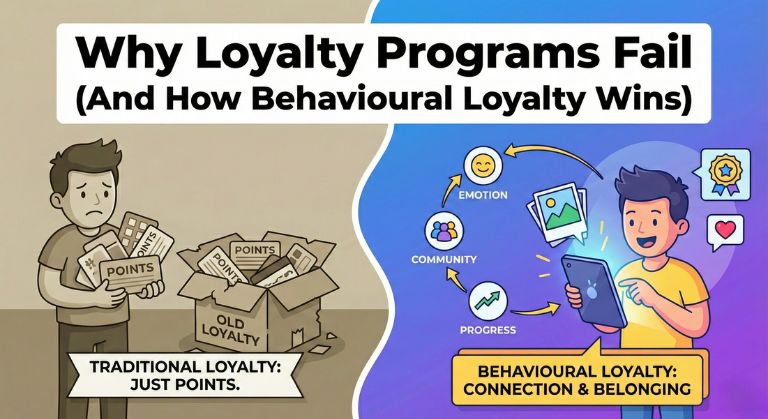
Why Loyalty Programs Fail (And How Behavioural Loyalty Wins)

Points, tiers, and discounts- the holy trinity of traditional loyalty programs. They worked when customer choices were limited, and switching costs were high. But today, every product is one click away, every discount is one copycat deep.  At ConSoul, we’ve seen loyalty fail not because people stop loving brands, but because brands stop learning from people. Behavioural loyalty fixes that gap- by making every interaction a feedback loop, not a transaction.    The Loyalty Illusion- When Points Stop Paying Off  Most loyalty programs over-index on purchase frequency and ignore emotional frequency. They reward buying, not belonging.  In 2023, 78% of consumers globally were enrolled in at least one loyalty program, but only 45% actively used them. Why? Because rewards are too transactional, and experiences too generic.  A coffee chain giving 10th-cup-free incentives doesn’t build loyalty; it builds habit until someone else gives the 9th cup free. Loyalty isn’t price elasticity- it’s emotional affinity.    Case Study- From Points to Participation (BFSI Example)  A large BFSI brand came to us with a loyalty problem: 1.5 million users, but declining active participation despite new reward tiers. The loyalty engine rewarded only spending- not engagement.  We redesigned the framework around micro-actions:  Completing digital KYC.  Setting financial goals in-app.  Referring a friend.  Consistent monthly savings.  Each action triggered contextual recognition (not just points): badges, progress dashboards, and personalized milestone nudges.  Within 90 days:  Active participation rose 32%.  Inactive users dropped by 18%.  Referral-based acquisition grew 11%.  Behaviour created engagement- the points were just punctuation.    The Psychology Behind Behavioural Loyalty  Loyalty is driven by three motivators: Autonomy, Achievement, and Recognition.  Autonomy: users want to choose how they earn or engage. Give flexible ways to participate.  Achievement: reward completion, not just consumption. A badge earned feels more personal than a coupon applied.  Recognition: public or private acknowledgment- “You’ve unlocked our Top Contributor Tier”- triggers dopamine far stronger than a discount.  ConSoul’s frameworks integrate all three, ensuring that loyalty feels like progress, not payout.    Why Traditional Loyalty Programs Break Down  Let’s dissect the five most common reasons loyalty engines underperform:  Problem  Consequence  Behavioural Fix  Rewards only tied to spend  Users disengage post-purchase  Add engagement and feedback milestones  One-size-fits-all tiers  Mid-segment users feel ignored  Use dynamic tiers based on behaviour depth  Lack of surprise  Predictable rewards = fatigue  Introduce random micro-rewards  Static communication  Feels impersonal and mechanical  Trigger real-time contextual nudges  No post-redemption engagement  Loyalty loop ends abruptly  Continue with reactivation triggers  Loyalty fails when it becomes a department instead of a design philosophy.    Case Study- Behavioural Loyalty in D2C  A sustainable D2C brand noticed high first-purchase conversion but weak repeat intent. Their “5% off next purchase” strategy was driving discounts, not devotion.  We replaced it with a behavioural loyalty engine that rewarded:  UGC uploads (customer photos on social).  Product reviews within 7 days.  Sharing eco-tips from the brand’s blog.  Each action unlocked non-monetary perks- early access, product naming votes, limited-edition colours. The impact was immediate:  Repeat rate +24%.  User-generated content tripled.  Customer satisfaction scores increased 19%.  This is how loyalty becomes advocacy.    Framework- ConSoul’s Behavioural Loyalty Loop  Our approach is built on three continuous phases:  Detect: Identify valuable micro-actions (referrals, reviews, repeat visits).  Design: Map these actions to motivational rewards (status, access, recognition).  Deepen: Reinforce behaviours through contextual journeys, not static offers.  This creates a loyalty loop– where engagement generates data, data refines journeys, and journeys inspire more engagement.    Data + Emotion = Retention  Behavioural loyalty isn’t anti-data- it’s data with empathy. We use interaction analytics to understand emotional momentum- when users feel seen, not sold to.  For a retail client, tracking “review submission after delivery” became the single strongest retention predictor. We automated appreciation messages and VIP previews for those reviewers. Their churn dropped 28%.  Loyalty was hidden in gratitude, not gamification.    The Future of Loyalty- From Programs to Platforms  Tomorrow’s loyalty isn’t a static app- it’s a dynamic experience layer integrated into every customer touchpoint. Your product, app, and marketing should all speak the same behavioural language.  At ConSoul, we call this the Loyalty-as-Experience model- where personalization, retention, and feedback are interconnected, not departmentalised.  The result: loyalty that evolves as fast as your users do.    The Takeaway  Loyalty isn’t built in points dashboards; it’s built in the small, consistent acknowledgments that tell users they matter.  When brands shift from rewarding transactions to reinforcing behaviours, loyalty stops being a program- it becomes a partnership.  The strongest loyalty isn’t earned; it’s understood.   → Discover how ConSoul helps brands design behavioural loyalty frameworks that turn engagement into advocacy

Why Loyalty Programs Fail (And How Behavioural Loyalty Wins) Read More »

The Science of Micro Signals How Behaviour Predicts Retention

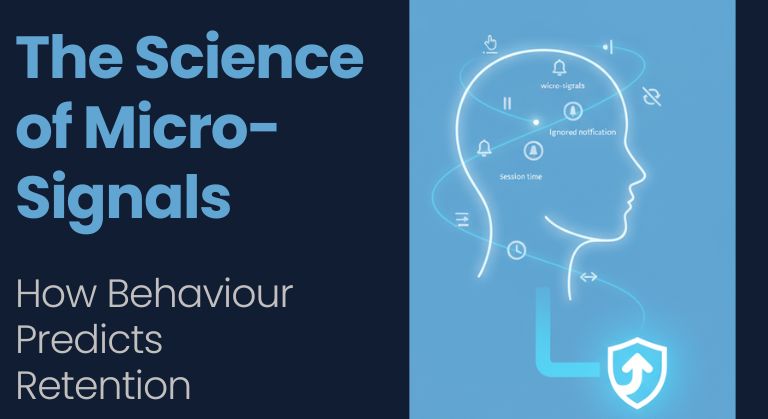
The Science of Micro-Signals- How Behaviour Predicts Retention

Not every user shouts before they leave. Some whisper.  The most powerful predictors of churn are hidden in micro-behaviours- tiny digital actions that reveal intent long before a drop-off.  At ConSoul, we build lifecycle strategies around those whispers. Because every scroll, pause, or hesitation is data about motivation. And when you can read those signals, you can change the story.  What Are Micro-Signals?  Micro-signals are behavioural indicators that sit between metrics and moments.  They don’t exist in dashboards by default- you must extract them from patterns.  Common examples include:  Scroll depth without conversion (interest but hesitation)  Repeated visits to the same page (intent reaffirmation)  Shortening session times over weeks (attention fatigue)  Ignored push notifications (signal saturation)  Each micro-signal alone is noise; combined, they tell a behavioural story.  Why Traditional Metrics Aren’t Enough  Open rates, CTR, and bounce rates measure response, not emotion.  They can tell you what happened, never why.  We found that brands relying only on standard metrics react too late. By the time a user stops opening emails, their disengagement started 10 days earlier in micro-signals.  For one eCommerce brand, shifting focus to behavioural data revealed that users who paused checkout for > 30 seconds on mobile were 40% more likely to abandon. We added a contextual nudge within that window- conversion rose by 18%.  Micro-signals don’t replace analytics. They make analytics human.  How We Decode Micro-Signals at ConSoul  We treat behaviour as data, but analyse it like psychology. Our process follows four steps:  Collect intent-rich events– scroll depth, time on page, click density, and cursor movement (using heatmaps and journey logs).  Cluster patterns– group users by behavioural velocity (fast browsers vs deep readers vs repeat visitors).  Correlate with outcomes– connect micro behaviours to macro results (purchase, drop-off, referral).  Trigger responses– personalised messaging or journey branching based on behavioural stage.  This behavioural layer lets us predict user fatigue and design interventions before a drop occurs.  Case Study- Early Reactivation in EdTech  An education platform was losing students after the first week of course enrolment.  Traditional CRM metrics flagged them as “inactive” after 14 days- too late.  We built a micro-signal model that flagged users who:  Stopped scrolling through modules mid-way.  Reduced session length by > 30%.  Skipped more than two quizzes in a row.  Those users received contextual nudges like: “Your next lesson unlocks a badge- resume now.”  Engagement rebounded in 48 hours and overall course completion rose 22%.  The insight: drop-off wasn’t disinterest- it was momentary friction.  Framework- From Data to Decision  ConSoul’s Behaviour-Led Lifecycle Framework bridges micro data with macro strategy.  Stage  Signal Type  Action  Outcome  Discover  Curiosity signals (hover time, scroll depth)  Personalised content sequence  Higher content retention  Decide  Hesitation signals (back and forth between plans)  Dynamic FAQs + trust nudges  Reduced abandonment  Use  Fatigue signals (session time drops)  Contextual push with value add  Increased daily active users  Re-engage  Drift signals (inactivity > 14 days)  Reactivation email + content recap  Faster return rate  Micro-Signals vs Personalisation 2.0  Traditional personalisation stops at “Hi {name}.”  Behavioural personalisation adapts in real time.  For a BFSI client, we monitored micro behaviours inside their app- where users paused while applying for loans. By embedding in-app clarity tooltips right before those points, form completion rose by 31%.  True personalisation is not about profiles- it’s about predicting confusion.  Common Missteps Brands Make  Over-instrumentation– tracking every event creates noise and privacy issues.  Isolated analysis– seeing micro signals without journey context leads to false positives.  Lack of response logic– collecting behaviour without an automation plan.  ConSoul’s rule: If you track it, decide why and what you’ll do when it changes.  Building a Culture That Understands Micro-Behaviour  Tools can track behaviour, but teams must interpret it.  We encourage clients to run monthly “behaviour roundtables”- cross-functional reviews where CX, marketing and product teams decode behaviour together.  It’s less about dashboards and more about stories: why did the user hesitate? why did they return?  The Takeaway  Micro-signals aren’t minor data points- they’re the language of customer emotion.  When brands learn to listen to them, retention stops being a reaction and becomes a relationship.  The difference between a churned user and a loyal one is often just a few unread signals.  → Learn how ConSoul uses behavioural data to build predictive journeys that keep users engaged

The Science of Micro-Signals- How Behaviour Predicts Retention Read More »

The Martech Mess- 5 Red Flags You’re Over-Stacked

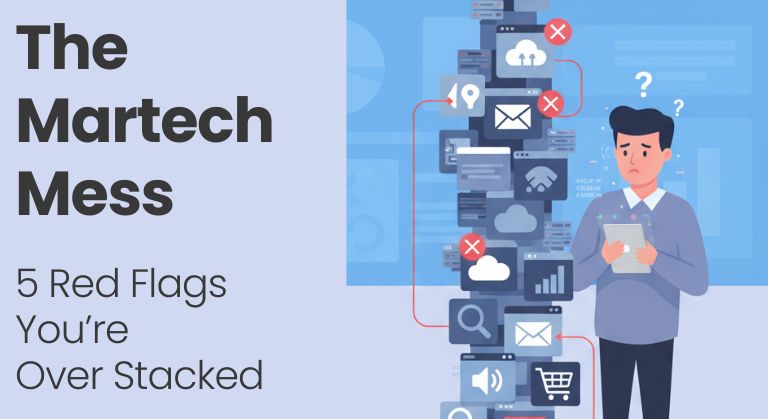
The Martech Mess- 5 Red Flags You’re Over-Stacked

When every marketing challenge triggers “let’s buy another tool,” you’re building complexity, not capability.  In 2024, the average mid-market brand runs 9–14 MarTech tools. Less than half of those talk to each other.  At ConSoul, we call it The Martech Mess– a well-intentioned tech labyrinth where teams drown in dashboards and data sits in silos.  Here’s how to spot when your stack has stopped serving you.    1. You’re Solving Symptoms, Not Systems  Buying a new CRM to fix low open rates, or a new analytics platform to fix attribution?  You’re treating symptoms.  One retail client we audited had 11 tools chasing the same KPIs. Each tool fixed one metric temporarily but created three new data conflicts.  When we traced the issue, the real cause was inconsistent data capture across channels.  Fix: start every tool discussion with:  “What problem will this solve across systems- not inside them?”    2. Your Teams Are Talking in Different Data Languages  If your CRM team calls an “active user” anyone who opens an email, while analytics defines it as a site session in 30 days- your dashboards will lie to each other.  This happens when each platform defines success in isolation.  At ConSoul, we unify taxonomies first: every term, trigger, and conversion event means the same thing everywhere.  Once that happened for a fintech client, marketing and product finally saw identical conversion funnels for the first time.  Fix: run a data dictionary workshop before you buy another tool.    3. You Collect More Data Than You Can Use  Data isn’t oil if you never refine it.  Brands often capture terabytes of clickstream, loyalty, and campaign data- then use 3%.  An eCommerce client stored 24 months of customer interactions across five systems, but only analysed six touchpoints monthly.  We built a signal hierarchy—ranking events by predictive value (e.g., “time to second session” > “email open”).  The result: data volume −60%, decision speed +45%.  Fix: collect less, correlate more.    4. Your Stack Grows Faster Than Your Strategy  Adding tools faster than you add goals leads to bloat.  In 2023, one travel client added 3 new platforms within six months- none connected to the CDP.  The marketing lead admitted: “We have more integrations than ideas.”  Our approach was to build a MarTech blueprint– a one-page map linking each tool to one business outcome.  We trimmed the stack by 40%, reallocated the budget to journey orchestration, and saw 1.8× campaign throughput.  Fix: draw your stack like an org chart. If two tools own the same function, one must go.    5. Your ROI Feels Invisible  If your ROI deck starts with “it’s complicated,” that’s the red flag.  Stack fragmentation kills attribution. When a journey spans five platforms- CRM, push, analytics, loyalty, ads- none can see the whole loop.  For a BFSI brand, we connected all journey IDs into a single orchestration layer.  ROI tracking went from 4 reports in Excel to one dashboard in real time.  Spend transparency improved 33%; budget waste fell by 20%.  Fix: integration before attribution. You can’t measure what you can’t connect.    When Martech Becomes Human Again  Technology should amplify teams, not intimidate them.  A streamlined stack frees marketers to focus on creative and strategic thinking- not maintenance.  We’ve seen first-hand that when the stack shrinks and clarity returns, cross-functional energy soars.  At ConSoul, our principle is simple:  Tech agnostic. Goal aligned. Human first.  That’s how you make Martech human again.    ConSoul’s 5-Step Stack Rationalisation Framework  Map– Audit every tool, integration, and owner.  Measure– Quantify time, cost, and overlap.  Merge– Consolidate functions into one orchestration layer.  Monitor– Real-time dashboards for cross-team visibility.  Maintain– Quarterly stack reviews aligned to business goals.  This framework has cut client stack costs by 25–50% and raised marketing velocity by up to 2×.    The Takeaway  If your Martech stack feels like a maze, you don’t need a map- you need a minimalist mindset.  The goal is not to own more platforms; it’s to own the customer journey end-to-end.  Every tool should have a purpose you can explain in one sentence.  If it doesn’t, you’re over-stacked.    → Read how ConSoul helps brands simplify their MarTech stacks for clarity and growth

The Martech Mess- 5 Red Flags You’re Over-Stacked Read More »

The Real Cost of Ignoring Retention- Lessons from Three Industries

The Real Cost of Ignoring Retention- Lessons from Three Industries

  Every marketer talks about acquisition. Few measure what it costs to replace the customers they lose.  At ConSoul, we’ve spent years helping brands shift from chasing new users to retaining the ones they already earned- and the numbers are revealing.  Ignoring retention isn’t just inefficient. It’s expensive, invisible, and often irreversible.    Retention vs. Acquisition- A Data Reality Check  Across categories, acquiring a new customer costs 5–7 times more than retaining an existing one.  But the gap isn’t just financial- it’s structural.  Travel: Acquisition is highly seasonal; retention builds stability between seasons.  BFSI: Cross-sell and loyalty drive margins; new users often require costly onboarding.  D2C: CACs have surged 60–80% post-2022, while repeat buyers contribute 45–60% of total revenue.  Retention isn’t just a “CRM function.” It’s the compounding interest of marketing.    Industry 1- BFSI: Retention as a Trust Engine  In banking and fintech, the challenge isn’t getting sign-ups- it’s keeping engagement after the first transaction.  We worked with a major BFSI brand where 60% of digital accounts went inactive within 90 days.  Our solution combined three data-led layers:  Engagement Scoring: Measured app interactions, transaction depth, and time between sessions.  Micro-Triggers: Automated reminders around EMI dates, statements, and small wins like “Your card usage hit a milestone.”  Human Touchpoints: Periodic satisfaction prompts routed through relationship managers.  Outcome: Within one quarter, activation retention rose by 38% and referral-led acquisitions grew organically by 14%.  Retention in BFSI isn’t about offers- it’s about building confidence through continuity.    Industry 2- Travel: Turning Intent Into Loyalty  A leading online travel platform was losing 70% of its users between “search” and “checkout.”  Instead of more discounts, ConSoul built a behaviour-driven abandonment sequence that adjusted follow-ups based on:  Destination frequency,  Price sensitivity, and  Device usage patterns.  Example:  Users who searched Toronto → Vancouver three times received a contextual email- “Still planning your Vancouver trip?”- paired with real-time fare drops.  No promo codes. No spam.  The brand achieved a 2x increase in conversions and cut remarketing spend by 40%.  Retention here began before the first booking.    Industry 3- D2C: The Post-Purchase Blindspot  In D2C, brands obsess over the first conversion and forget the second.  We worked with a sustainable lifestyle brand that discovered 82% of buyers never returned after one purchase.  Our post-purchase loop introduced three interventions:  Usage Feedback: “How are you liking your new product?”  Care Content: A short email with tips for product longevity (aligned with the brand’s eco-mission).  Reactivation Incentive: Instead of discounts, users unlocked early access to a new drop after engaging twice.  The result: repeat purchases grew by 27% in 60 days.  Retention isn’t driven by incentives- it’s driven by relevance and timing.    Why Retention Is Everyone’s Job  Retention is not a department.  It’s the invisible connective tissue across marketing, product, and customer service.  Product teams create consistency through usability.  CRM teams identify moments to re-engage.  Performance teams allocate budgets based on lifecycle value.  When all three align, retention becomes a multiplier, not a metric.    ConSoul’s Framework- From Reactive to Predictive Retention  Most brands measure churn after it happens.  Our retention framework flips the logic:  Stage 1: Detect– Using engagement decay curves to flag early drop risks. Stage 2: Design– Automate reactivation sequences based on behavioural clusters. Stage 3: Deepen– Build “micro-loyalty” layers- small, consistent value moments that make users stay longer.  Retention is not one campaign; it’s an ecosystem that learns.    The Takeaway  Retention isn’t a project you run once a year.  It’s a mindset shift that redefines ROI from “reach” to “relationship.”  When done right, it reduces acquisition dependency, increases predictability, and makes marketing measurable in ways ads alone never can.  Retention is the new growth channel.  → Discover how ConSoul helps brands design retention-first growth strategies across industries

The Real Cost of Ignoring Retention- Lessons from Three Industries Read More »

Early Indicators of Customer Loyalty and How to Nurture Them

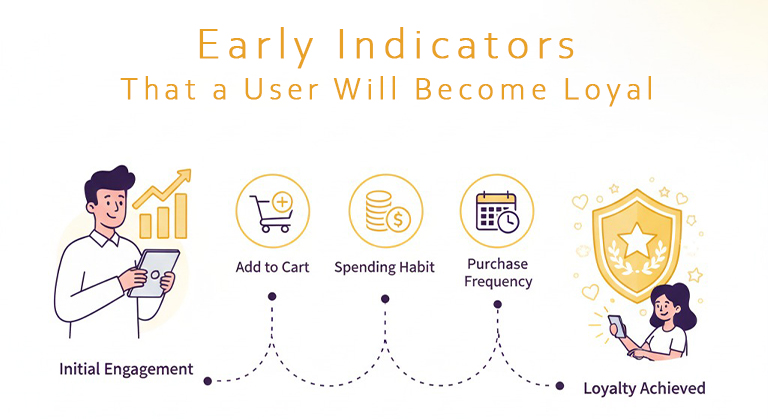
Early Indicators That a User Will Become Loyal

The behaviors that predict long-term value — and how to double down on them  In today’s crowded marketplaces, acquiring a user is just the start. True business growth depends on converting that acquisition into long-term loyalty — repeat usage, advocacy, and increased customer lifetime value (CLV). But loyalty doesn’t just emerge over time. In fact, it’s often predictable based on early behaviors users exhibit soon after first contact.  Understanding these signals is critical. If you can identify loyalists early, you can invest in nurturing them, improving retention, revenue, and marketing efficiency.  So what early behaviors predict loyalty — and how can brands act on them? Let’s break it down.  First-time behaviors that predict loyalty  Some users show signs from the very first interactions that they’re likely to stay. These signals often occur within the first few days or weeks, and their presence strongly correlates with retention.  Key early indicators include:  Repeat visits in a short time frame: A user who returns to your site or app within 48 hours of their first visit shows active interest.  Account creation or profile completion: Voluntarily setting up an account or adding personal details suggests a level of commitment.  Interaction with onboarding flows: Completing tutorials, FAQs, or setup guides signals that the user is willing to invest time to “get value” from your product.  The earlier these behaviors occur, the stronger their predictive value. These users are already demonstrating curiosity and intent.    Engagement depth vs. frequency: which matters more?  Not all engagement is created equal. For instance, a user might visit your website five times but merely browse the homepage each time — versus another user who visits twice but explores multiple categories, adds items to a wishlist, or reads detailed product descriptions.  Depth of engagement often predicts loyalty better than pure frequency. Look for behaviors like:  Saving products or content for later  Leaving reviews or feedback  Exploring your loyalty or referral program details  These actions show not just interest, but a willingness to form a relationship with your brand — an early loyalty marker.    Early signs of emotional investment  Loyalty isn’t purely transactional. It often begins when users feel emotionally connected to your brand or offering.  Indicators of emotional investment include:  Following your brand on social media early in their journey  Sharing content or tagging your brand  Voluntarily signing up for notifications or newsletters, even before purchase  These behaviors signal that the user is open to a longer relationship. They’re not just shopping — they’re joining your ecosystem.    Multi-channel participation as a loyalty signal  Today’s best customers rarely interact on a single channel. Multi-channel behavior is a strong early indicator of future loyalty.  Examples include users who:  Visit your website and download your app  Engage with both email and WhatsApp messages  Use mobile, desktop, and in-store channels interchangeably  Cross-channel engagement suggests a user is investing time in your ecosystem, increasing their stickiness. These users are worth nurturing with tailored experiences and rewards.    First purchase characteristics that predict CLV  If your business revolves around transactions (eCommerce, retail, fintech), the nature of a user’s first purchase can reveal much about their future value.  Key predictors:  Average order value (AOV): Customers with higher AOV on their first purchase often have higher lifetime value.  Product category: Certain products attract more loyal customers; for example, essentials and replenishable goods often lead to repeat purchases.  Payment method: Customers who choose subscription or auto-renewal at the outset are strong candidates for loyalty.  By monitoring these factors, brands can identify which users to prioritize for further nurturing.    How to double down on early loyalty signals  Detecting these signals is only part of the equation. The real opportunity is knowing how to act quickly when early loyalty indicators appear.  Practical next steps include:  Personalized journeys: Tailor communications immediately for high-potential users. For instance, users who show multi-channel behavior can receive cross-device reminders or suggestions.  Exclusive offers or loyalty nudges: Encourage second purchases quickly with limited-time rewards or membership program invitations.  Reduce friction: Make it easy for these users to engage further — fast checkout, saved preferences, one-click reorders.  Accelerate trust-building: For financial services, this could mean pre-filling forms, easing KYC processes, or fast-tracking onboarding for promising segments.  Brands that move quickly can translate these early behaviors into deeper, longer-term relationships.    Common false positives to avoid  It’s equally important to recognize behaviors that might look like loyalty indicators but often aren’t.  For example:  Contest participation: Engagement driven purely by incentives may not translate into genuine interest or retention.  High-velocity browsing: Users who browse extensively but without focus may not convert into buyers or subscribers.  Effective MarTech strategy requires separating real loyalty signals from noise, so resources are invested wisely.    The role of MarTech in operationalizing early loyalty detection  Modern marketing technology platforms can help brands detect, score, and act on these early indicators at scale:  CRM platforms can segment high-potential users automatically  Customer journey tools can trigger timely nudges  Analytics platforms can identify patterns in behavior tied to long-term value  But platforms alone aren’t enough. The key is a smart strategy that knows what to look for and how to respond fast.    Closing thought: Loyalty starts early  Many brands think loyalty is something that develops over years.  In reality, loyalty starts early — often in the first hours or days of a user’s journey.  At ConSoul, we help brands unlock these insights and build lifecycle journeys that move users from interest to advocacy efficiently and sustainably.  Want to learn what signals predict loyalty in your user base? Let’s talk. 

Early Indicators That a User Will Become Loyal Read More »